Thumbnail Psychology: Why Viewers Click (or Don't)
The science behind high-converting thumbnails and a repeatable framework for designing them faster.
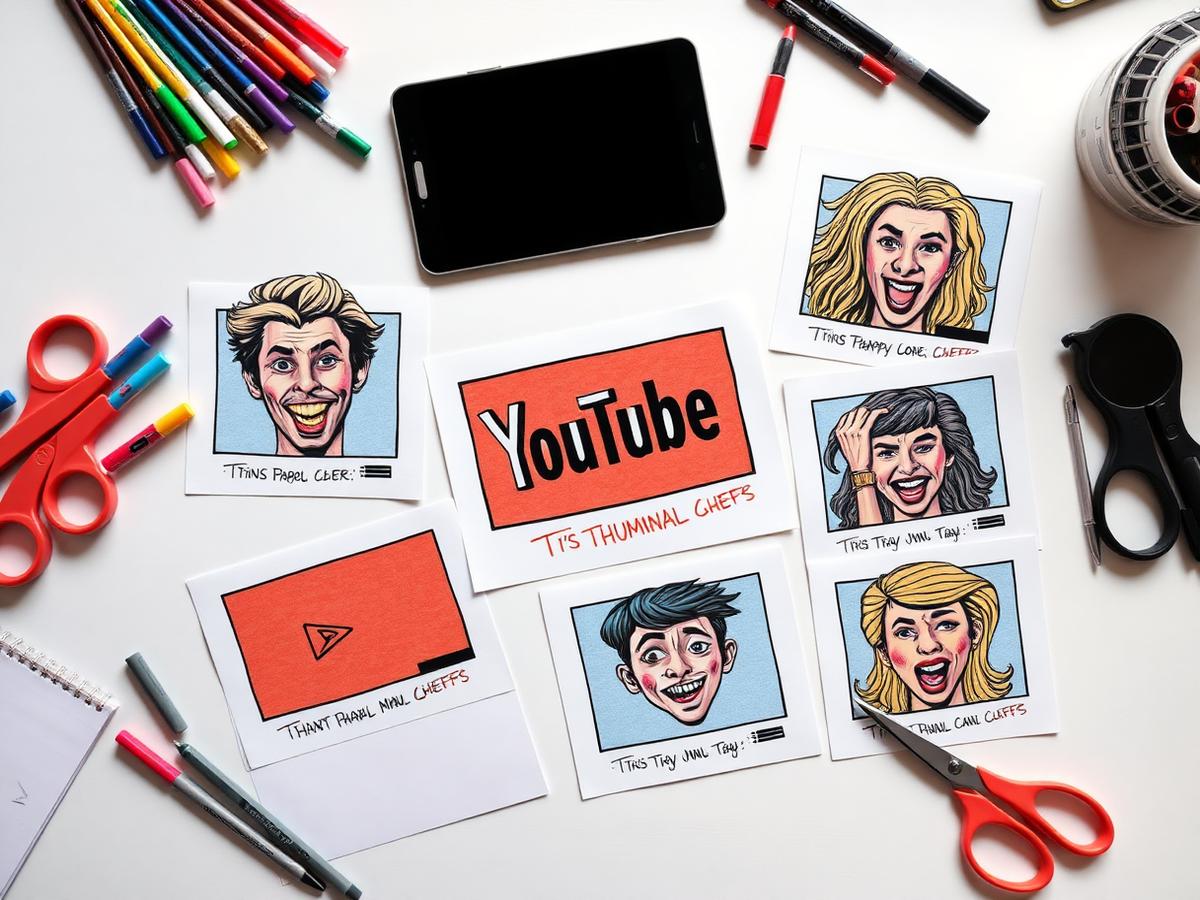
A viewer decides whether to click in well under a second, on a screen where your thumbnail is smaller than a postage stamp and surrounded by competitors. Good thumbnails are not prettier — they are easier to decode.
The three-glance test
- Glance one (0.1s): can the eye find one clear subject? If there are two focal points, you already lost.
- Glance two (0.3s): is there an emotional signal — a face, a reaction, a before/after, a threat?
- Glance three (0.6s): does the text add information the title does not repeat?
Why contrast beats detail
At mobile size, detail disappears and only shapes and contrast survive. Push your subject away from the background with light, colour or a cut-out edge. A slightly 'cheap' looking thumbnail that reads instantly will outperform a polished one that turns to mud at 210 pixels wide.
Text rules that hold up
- Three to four words. Six is a paragraph at thumbnail size.
- Never duplicate the title — use the thumbnail to add the second half of the idea.
- One weight, one colour, one accent. Two competing colours read as noise.
- Place text where the timestamp badge and channel avatar will not cover it.
The emotional lever
Curiosity, stakes, relief and identity are the four levers that reliably move click-through. Curiosity opens a loop ('what happened next?'). Stakes show cost ('this mistake cost me $4,000'). Relief promises the end of pain ('finally fixed'). Identity signals belonging ('for people who edit alone at 2am'). Pick one lever per thumbnail — stacking them cancels them out.
Your thumbnail is not decoration. It is the shortest possible version of your argument.
A faster design workflow
- 1Write the promise as a sentence before opening any design tool.
- 2Sketch three concepts as ugly boxes — subject, text, background. Ninety seconds each.
- 3Build only the strongest concept properly.
- 4Shrink it to 210px wide and look at it on your phone. If you hesitate, simplify.
- 5Keep an archive of your own winners and study what they share, not what other channels do.
Thumbnails improve fastest when you treat them as testable claims rather than art. Ship, measure click-through in the first 48 hours, and iterate on the ones that under-deliver against your channel average.
Put this into practice
Stop reading. Start shipping.
CreatorIntent turns this kind of research into a complete video package — hook, thumbnail direction, titles, description, tags, and script outline — in under 5 minutes.
Plans from $9.99/mo·Cancel anytime·Locked-in pricing for early members